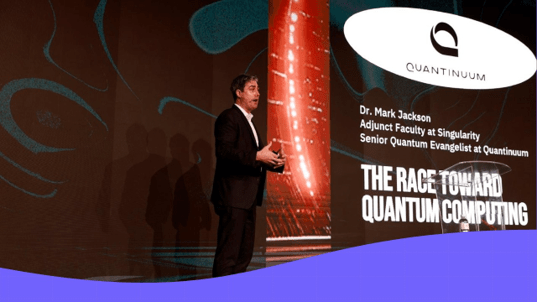
For the third consecutive year, Liberty Networks hosted the Links 2025 event, reaffirming its role as a leader in business connectivity across Latin America and the Caribbean. This edition brought together experts in emerging technologies, including renowned quantum computing specialist Mark Jackson, who analyzed the current and future impact of this groundbreaking technology.
During his presentation, Jackson clearly explained what quantum computing is, emphasizing that this groundbreaking technology relies on fundamental principles of quantum physics, such as superposition and entanglement.
These principles enable quantum computers to address and solve highly complex problems that are considered impossible for traditional computers due to the inherent limitations of classical computing.
Jackson asserts:
“Quantum computing is not just a faster computer; it is a completely different kind of computer that can solve problems that are absolutely impossible to address with current technology.”
He also emphasized that the field of quantum computing is currently undergoing an accelerated phase of development, with real-world applications that could begin to be implemented as early as this year, offering immediate solutions to critical challenges across various industries.
Advancements at Leading Institutions
Regarding its tangible impact, Jackson mentioned that world-leading institutions such as Google, IBM, and Microsoft, along with prestigious research centers like MIT, are already utilizing quantum computers to conduct applied experiments.
These organizations have demonstrated that a quantum computer can outperform the world’s most advanced supercomputers in specific tasks.
For example, in 2019, Google announced that it had achieved “quantum supremacy” by solving a problem in 200 seconds that would take a classical supercomputer approximately 10,000 years (NYTimes, 2024).
Jackson also highlighted that some financial institutions have already established teams dedicated exclusively to quantum computing, exploring applications such as investment optimization and risk management, leveraging the exponential speed and analytical capacity of quantum computers.
Adoption in Latin America
In Latin America, countries such as Brazil and Mexico are taking the initial steps toward adopting quantum computing, launching projects and collaborations to explore this disruptive technology, placing the region on a promising trajectory.
Jackson listed the numerous potential benefits that quantum computing could bring to humanity, highlighting its ability to revolutionize key sectors such as molecular chemistry, facilitating the creation of personalized medicines, financial optimization with greater precision and speed in the markets, improvements in cybersecurity through virtually invulnerable systems, and significant advances in artificial intelligence.
Jackson believes that:
“There is truly no industry that will not be impacted by quantum computing.”
He also emphasized the power of this technology to solve complex logistical challenges in seconds, which would typically take years of processing using traditional systems.
Technical Challenges and Projections
In terms of performance, Jackson explained that a quantum computer can process information exponentially faster than a traditional one. Unlike classical bits, which can only represent a 0 or a 1, qubits can represent multiple states simultaneously, enabling massive parallel computations.
This translates into capabilities millions of times faster compared to traditional computers.
Jackson also addressed the current challenges faced by quantum computing, noting that while functional prototypes of these computers already exist, significant efforts are still underway to improve the quality of qubits (the basic units of quantum information) and to significantly reduce error rates.
These technical factors are crucial for achieving widespread and effective adoption of this technology.
“We are very close to overcoming these challenges,” he assured, indicating that this will mark a definitive milestone in the history of modern technology.