

Why uptime no longer defines data center resilience
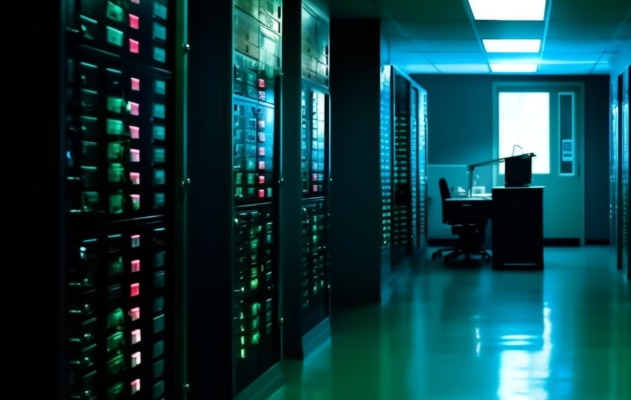
Can an invisible failure in a digital system bring down the services we use every day?
Artificial intelligence is pushing data centers to a point where resilience no longer depends solely on preventing outages, but on anticipating how increasingly complex systems interact.
There are moments when digital life comes to a brief standstill—an app that won’t load, a service that fails, a transaction that doesn’t go through—and what happens behind that silence is rarely visible. Within that invisibility, data centers operate as critical infrastructure now facing growing pressure driven by artificial intelligence and its demand for computational power and speed.
The advancement of artificial intelligence is pushing these systems to unprecedented levels of demand. Model training, massive data processing, and real-time inference workloads increasingly require greater computing capacity and energy.
In this context, digital infrastructure resilience is no longer measured solely by “uptime,” but by the ability to anticipate and manage risks in highly interconnected environments.
Interconnected infrastructure.
Incidents, in fact, are no longer typically triggered by the isolated failure of a single component. Instead, they emerge from the interaction between power systems, IT infrastructure, and cooling platforms.
Luis Santamaría, Cloud and Service Provider Segment Leader at Schneider Electric, explains that this interdependence requires a rethink in how these infrastructures are managed:
“Data centers have evolved into highly interdependent systems. An event in power can affect cooling, and a thermal issue can directly impact processing capacity.”
Globally, there are around 10,000 data centers across 164 countries, according to data from the United Nations Development Programme (UNDP), although their distribution is highly uneven. Latin America and the Caribbean account for just 4.8% of this digital infrastructure, highlighting the technological gap and the region’s growth potential.
Rising systemic risk.

In the industry, one of the most significant shifts is the move from isolated incidents to systemic failures, where multiple subsystems interact and create cascading effects. For example, a sudden increase in processing load can raise hardware temperatures.
The cooling system responds by increasing activity, making optimized management and maintenance critical to improving energy performance and operational efficiency.
When energy management is not aligned with system operations, overall balance can be compromised. Santamaría warns:
“Today we see more systemic risk: it is not a single component that fails, but the interaction between systems. Power, cooling, IT, and automation are so interconnected that any imbalance can quickly escalate into an operational issue.”
For years, operational continuity relied on redundancy: duplicating critical systems or adding backup generators. While these measures remain relevant, they are no longer sufficient on their own.
Modern data centers generate vast amounts of information on energy consumption, temperature, and workload behavior, opening the door to risk anticipation if properly analyzed.
However, this potential is still not fully leveraged. Santamaría puts it plainly:
“If we are honest as an industry, there is still a lot of reactive use of data. We have very powerful real-time sensors and monitoring, but in many cases they are only used to trigger alarms, not to anticipate decisions.”
The challenge, then, is to turn this data into predictive capability to anticipate operational scenarios. This shift is taking place amid strong sector expansion.
The report Latin America Data Center Market Landscape 2024 projects that colocation and edge data centers will grow by more than 25% annually in the region through 2026, driven by cloud services, advanced analytics, and artificial intelligence.
Global digital economy.
The importance of this infrastructure is also growing due to its role in the global digital economy. Data centers support financial services, e-commerce, telecommunications, healthcare systems, among other industries. At the same time, AI is driving new investments in technological infrastructure.
Countries such as China have announced more than US$70 billion allocated to data center development, while major tech companies are building increasingly powerful facilities to run AI models at global scale.
This growth requires upgrades in power systems, cooling, connectivity, and monitoring. In this context, Santamaría advocates for a shift in perspective:
“Resilience is no longer defined only as uptime, but as adaptability: understanding how the entire system responds to new scenarios and making decisions before an incident occurs.”
In a context of accelerating artificial intelligence expansion and growing reliance on digital infrastructure, data centers face a clear challenge: shifting from reacting to failures to anticipating them.
The resilience of the future will depend less on the accumulation of backup systems and more on a deep understanding of how the systems that sustain digital operations interact.

|
|